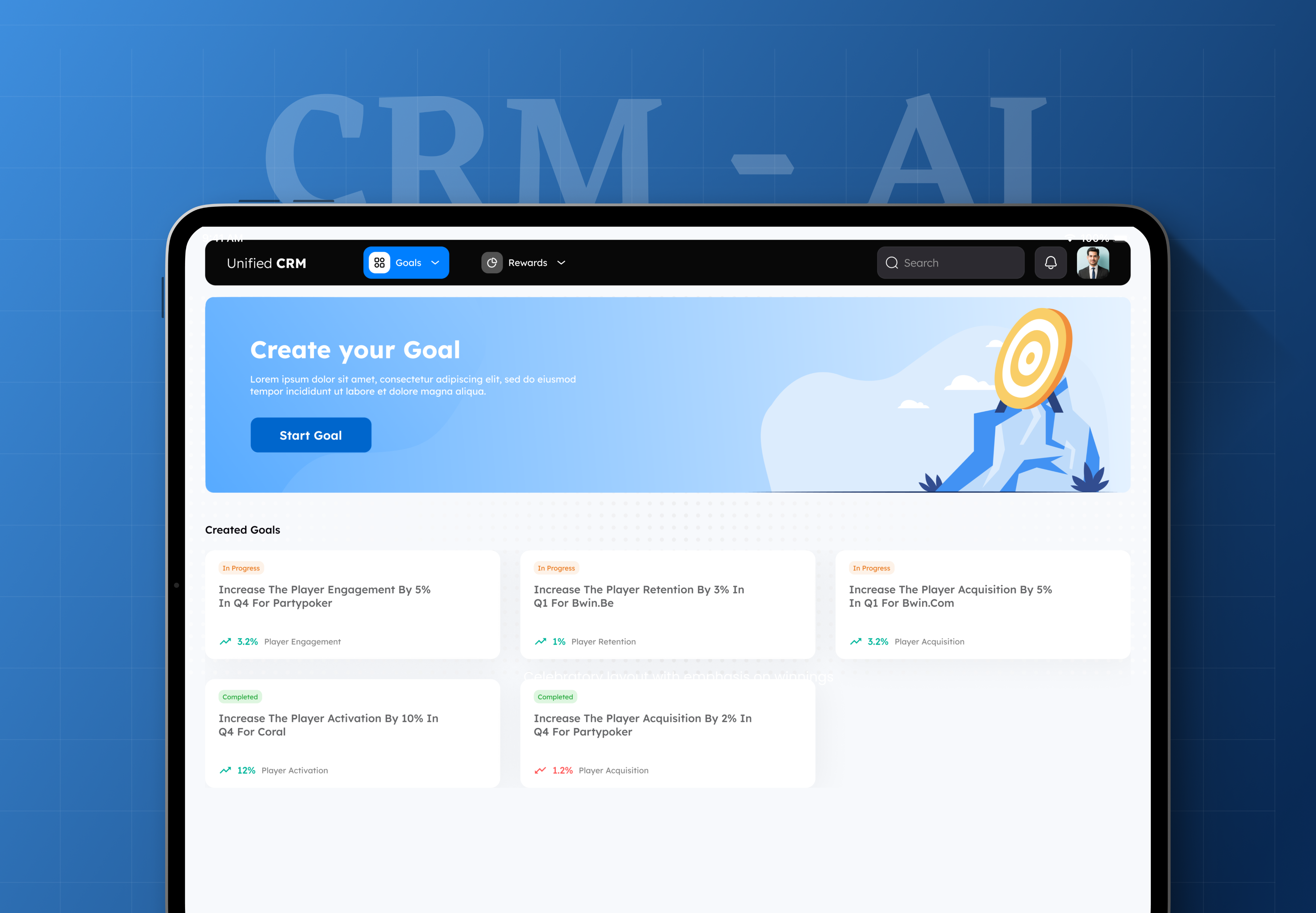
Problem Statement - Unified CRM (AI Driven)
In today's highly competitive market, businesses face challenges in efficiently managing customer relationships, executing targeted marketing campaigns, and measuring success across various regions and segments. Existing CRM systems lack the advanced capabilities needed to provide personalised insights, streamline campaign management, and ensure alignment with organisational objectives.
Challenges include:
- Fragmented tools for campaign creation, audience targeting, and performance analysis.
- Lack of AI-driven recommendations for optimising resource allocation, audience segmentation, and campaign strategies.
- Inability to align marketing goals with broader organisational OKRs (Objectives and Key Results).
- Limited visibility into campaign performance, resulting in ineffective decision-making.
Objective:To design a Unified AI-Driven CRM that consolidates all campaign management tools, integrates advanced AI capabilities such as Predictive and Prescriptive Analytics, and enables intelligent decision-making.
User Roles
Marketing Head
- Oversees the overall marketing strategy and ensures alignment with organisational objectives (OKRs). Provides direction for campaigns, approves goals, and monitors performance.
- Define and approve high-level marketing goals.
- Oversee budget allocation and ensure resources are utilised effectively.
- Monitor campaign performance and provide strategic direction.
- Approve or reject campaign proposals and schedules.

Thank You
CRM Manager
- Manages and coordinates customer relationship campaigns, focusing on audience segmentation, engagement strategies, and campaign execution. Ensures campaigns align with the company’s CRM objectives.
- Create, manage, and execute CRM-specific campaigns.
- Segment audiences based on user data and activities.
- Define campaign propositions (e.g., rewards, communication).
- Track and optimize CRM campaign performance using analytics.
Operations Executive
- Executes daily operations related to campaign management, ensuring smooth implementation and handling logistics, campaign configurations, and compliance with set rules.
- Assist with campaign setup, validation, and launch processes.
- Ensure compliance with regional and internal policies.
- Track campaign delivery and handle any operational issues.
- Collaborate with various teams to ensure campaigns are executed on time.
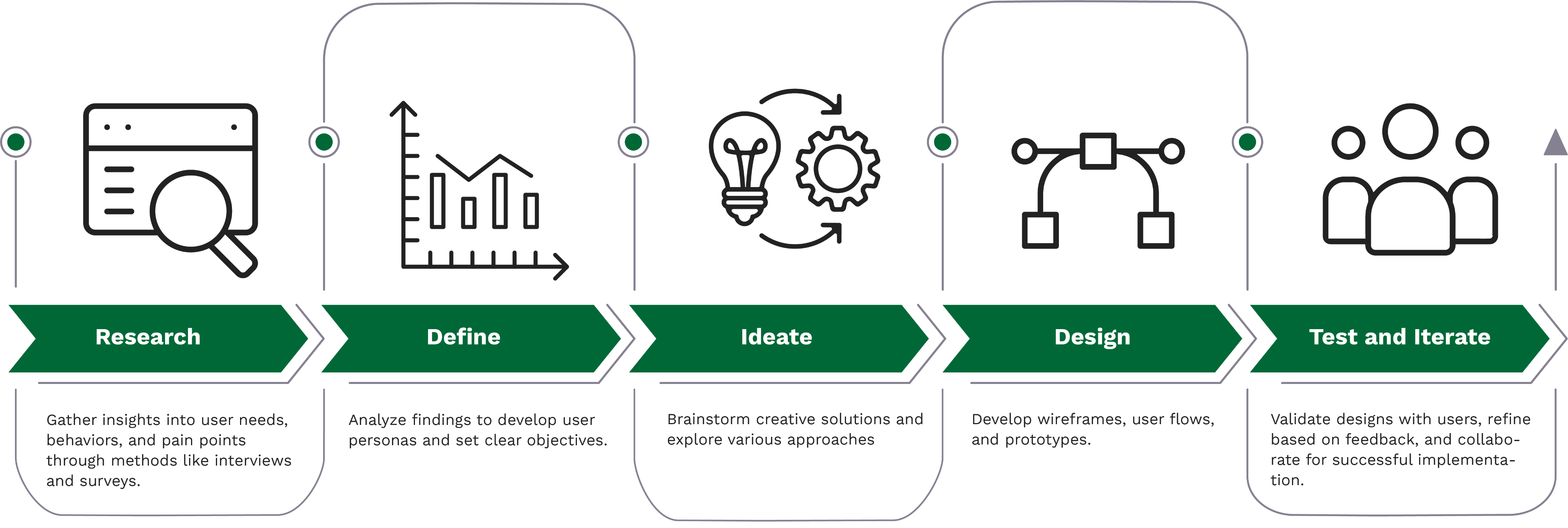
Design Process Followed

Target Device
Laptop/Desktop Resolution

Team includes
2 UX Designer, 2 UI designers, 1 Product Manager
Benchmarking
As part of benchmarking, I evaluated our business processes and performance metrics against industry standards and best practices from other AI-integrated CRM tools like Salesforce Einstein and Zoho CRM Plus, ensuring alignment with cutting-edge solutions and identifying areas for improvement and innovation.

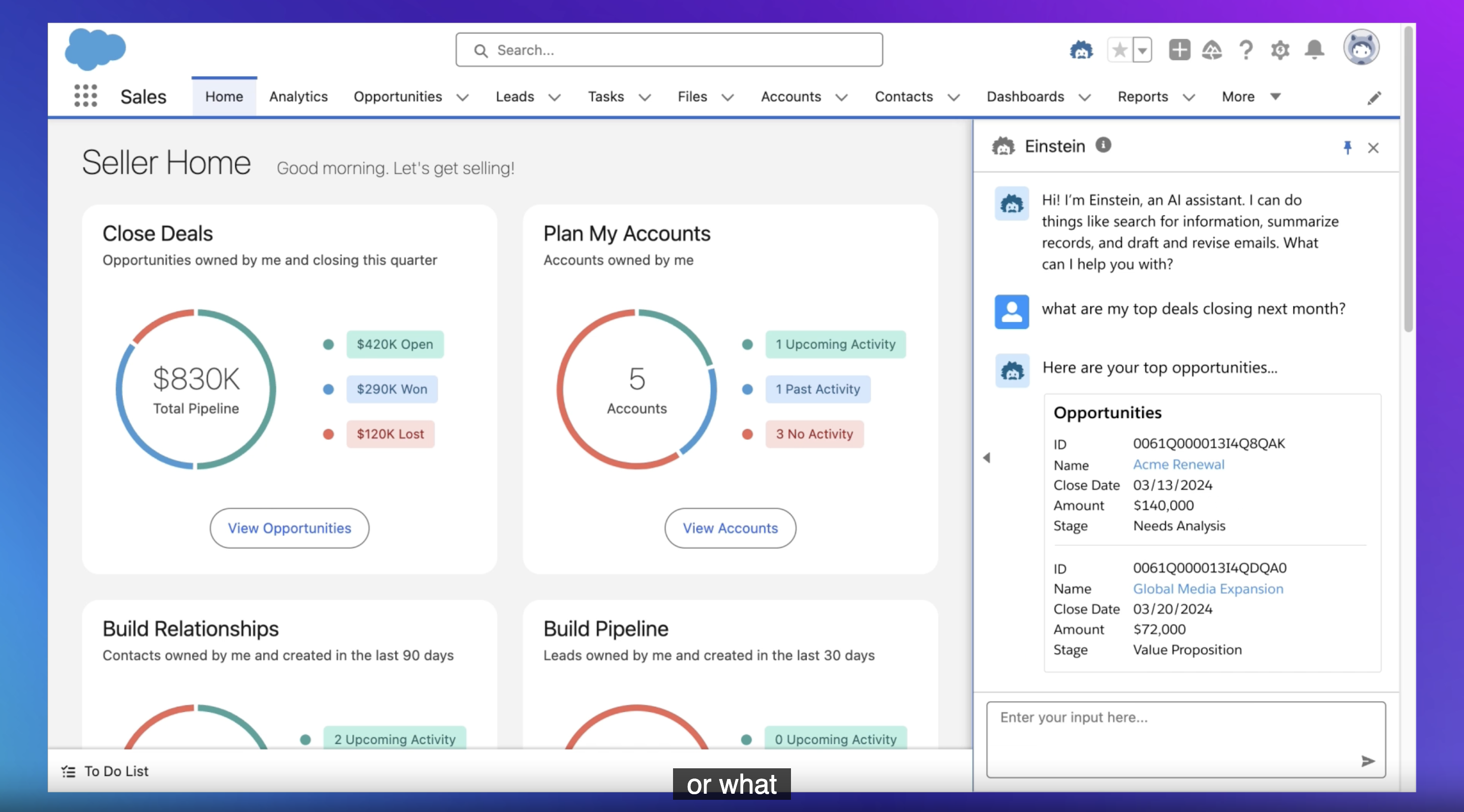
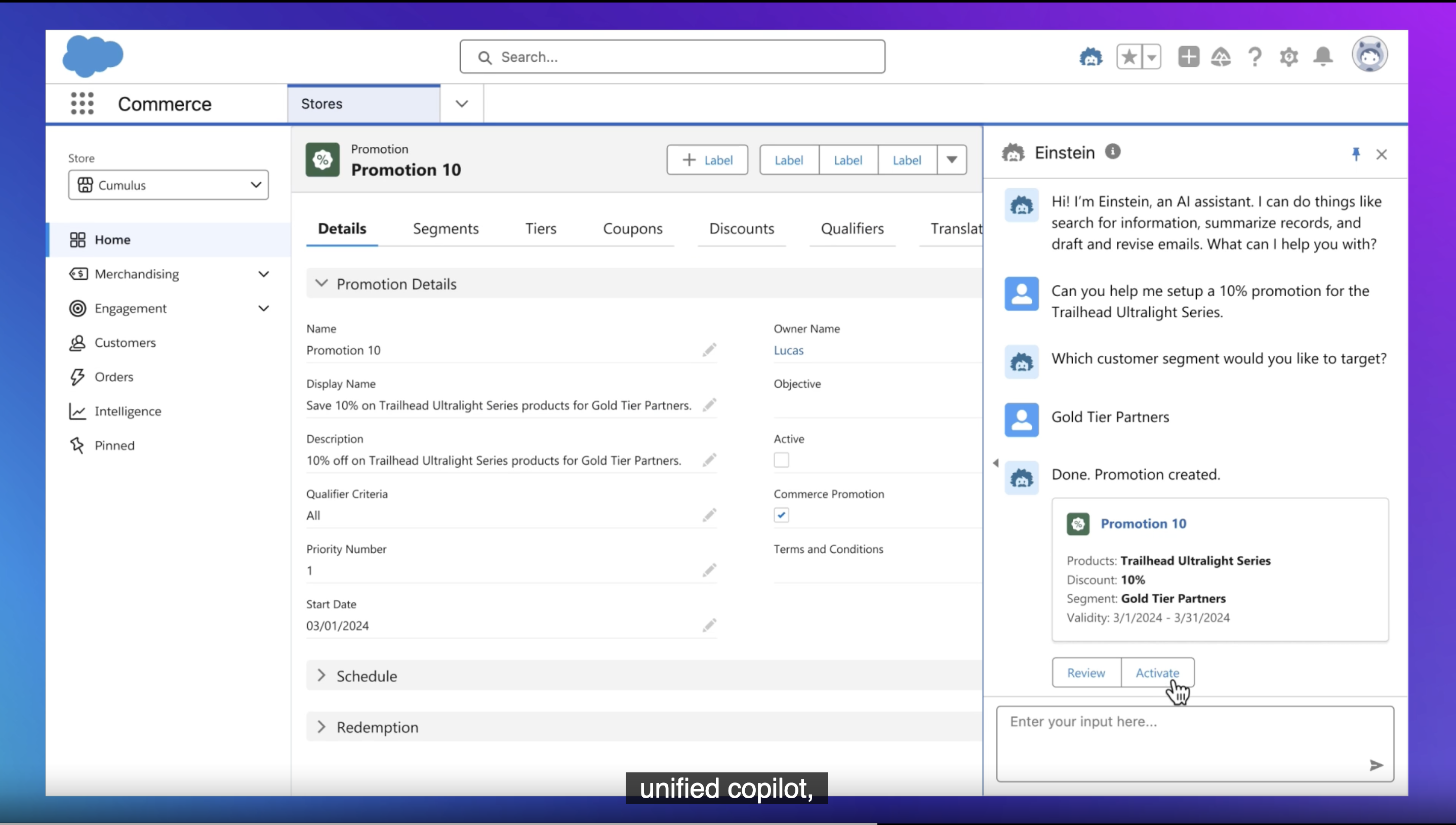
Salesforce EinsteinSalesforce Einstein offers a variety of AI-powered use cases and features that help businesses enhance customer interactions, streamline processes, and make data-driven decisions. Here are the few Key Features:
- Sales Forecasting & Lead Scoring: Uses machine learning to predict sales outcomes and automatically score leads, helping teams prioritise high-value opportunities and generate accurate revenue forecasts.
- Personalised Customer Service: AI-driven case classification and routing ensure that customers are connected with the right agent quickly, while Einstein Bots handle routine inquiries, improving response times and overall customer satisfaction.
- Marketing Campaign Optimisation & Insights: Provides AI-powered analytics and insights into customer behaviour, allowing marketers to fine-tune campaigns for higher engagement and conversion, while real-time performance tracking helps refine strategies.
- Churn Prediction & Next Best Action: Predicts customer churn and suggests the most relevant actions to re-engage at-risk customers, such as offering personalised support or upsell opportunities.
- Automation & Voice Interaction: Einstein automates repetitive tasks like data entry and follow-ups, and Einstein Voice allows users to interact with Salesforce through voice commands, improving productivity on the go.
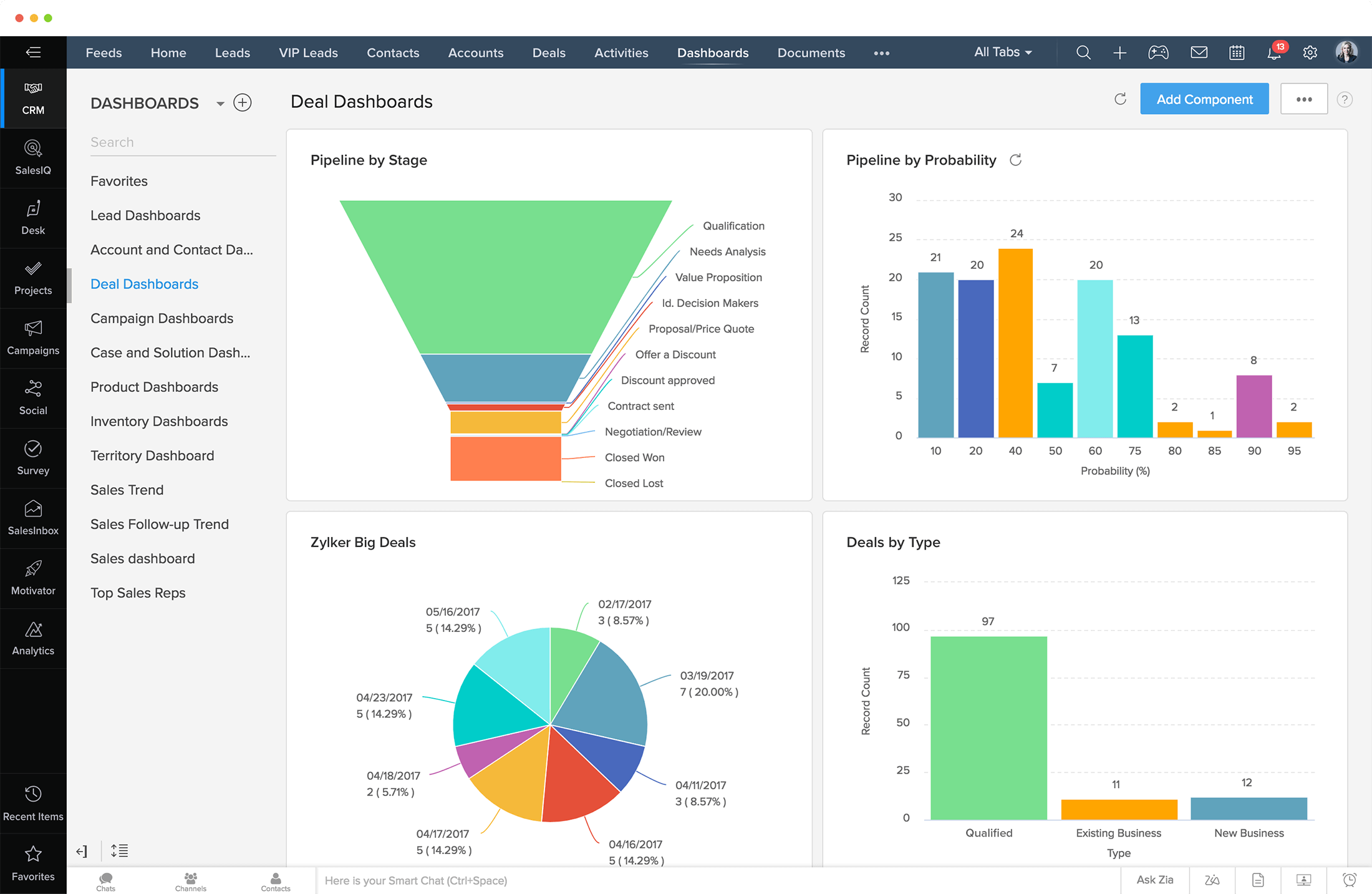
Zoho CRM Plus
Zoho CRM Plus is an all-in-one customer engagement platform designed to streamline sales, marketing, customer support, and analytics. It integrates multiple tools for omni channel communication, sales automation, customer journey mapping, and performance tracking. Powered by Zia, Zoho's AI assistant, it offers features like lead scoring, sales forecasting, and personalised customer interactions. With real-time insights and automation, Zoho CRM Plus helps businesses improve efficiency, enhance customer experiences, and drive growth across all touch points.
Some of the key Features:
- Omni channel Communication: Unifies email, social, chat, and phone interactions in one platform for consistent, efficient customer support.
- AI-Powered Sales Assistant (Zia): Provides lead scoring, sales forecasting, and suggestions for better sales outcomes.
- Advanced Analytics: Offers customisable dashboards for tracking campaign performance and customer behaviour.
- Workflow Automation: Automates tasks like lead assignment and follow-up reminders for improved efficiency.
- Customer Journey Mapping: Visualises customer journeys, enabling personalised, multi-step marketing campaigns.
Insights
After connecting with stakeholders and reviewing the research material from the previous Campaign Manager project, I identified the following key pain points
Some common pain points identified include:
- Difficulty aligning label-level goals with organisational OKRs.
- Limited and outdated audience segmentation options, affecting campaign effectiveness.
- Manual budget allocation processes prone to errors and lacking visibility.
- Rigid campaign proposition setup, restricting flexible reward strategies.
- Complex and inefficient campaign scheduling with no real-time adjustments.
- Lengthy approval workflows, causing delays in campaign execution.
- Inconsistent performance tracking due to unclear KPIs and limited real-time reporting.
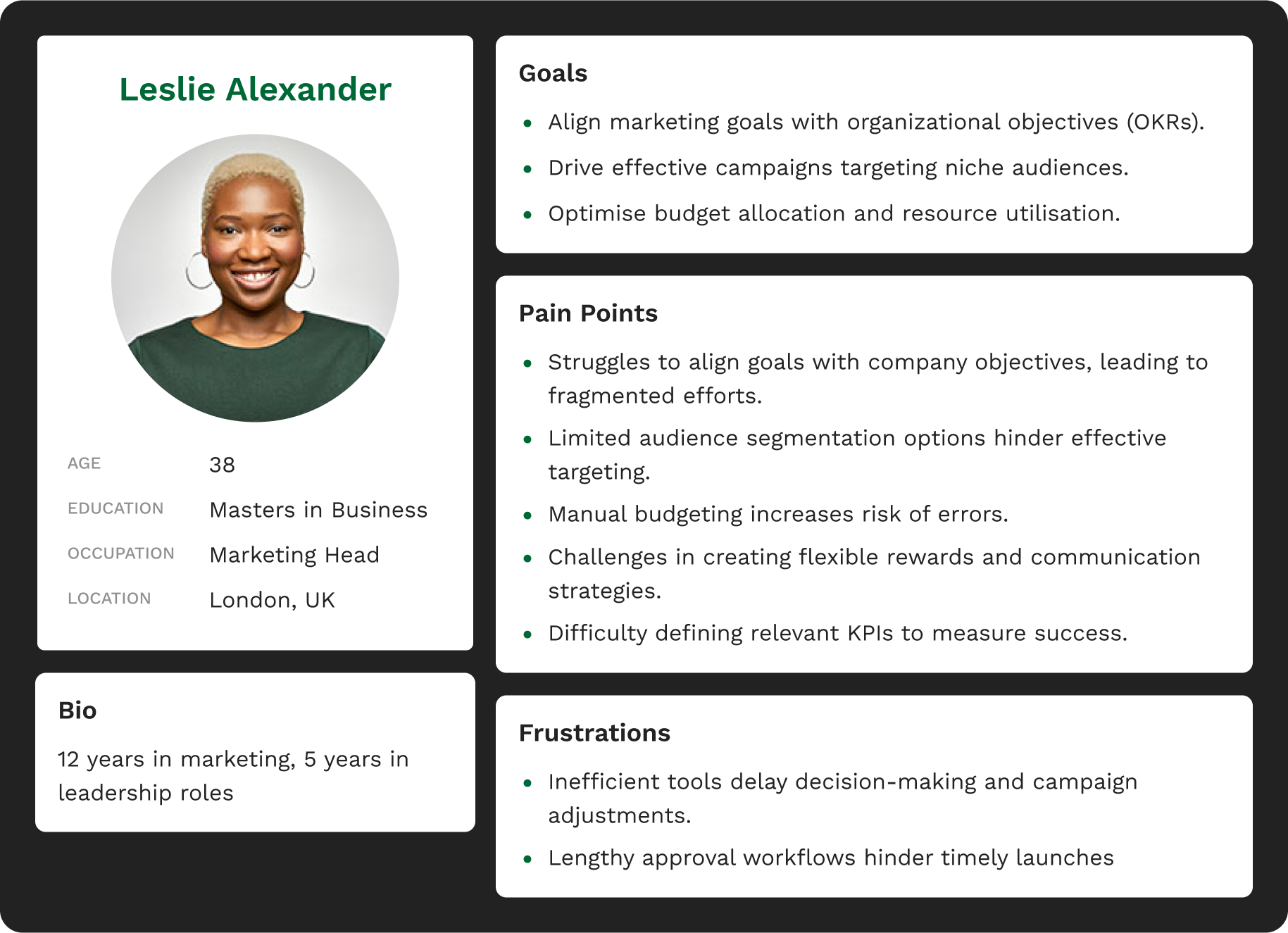
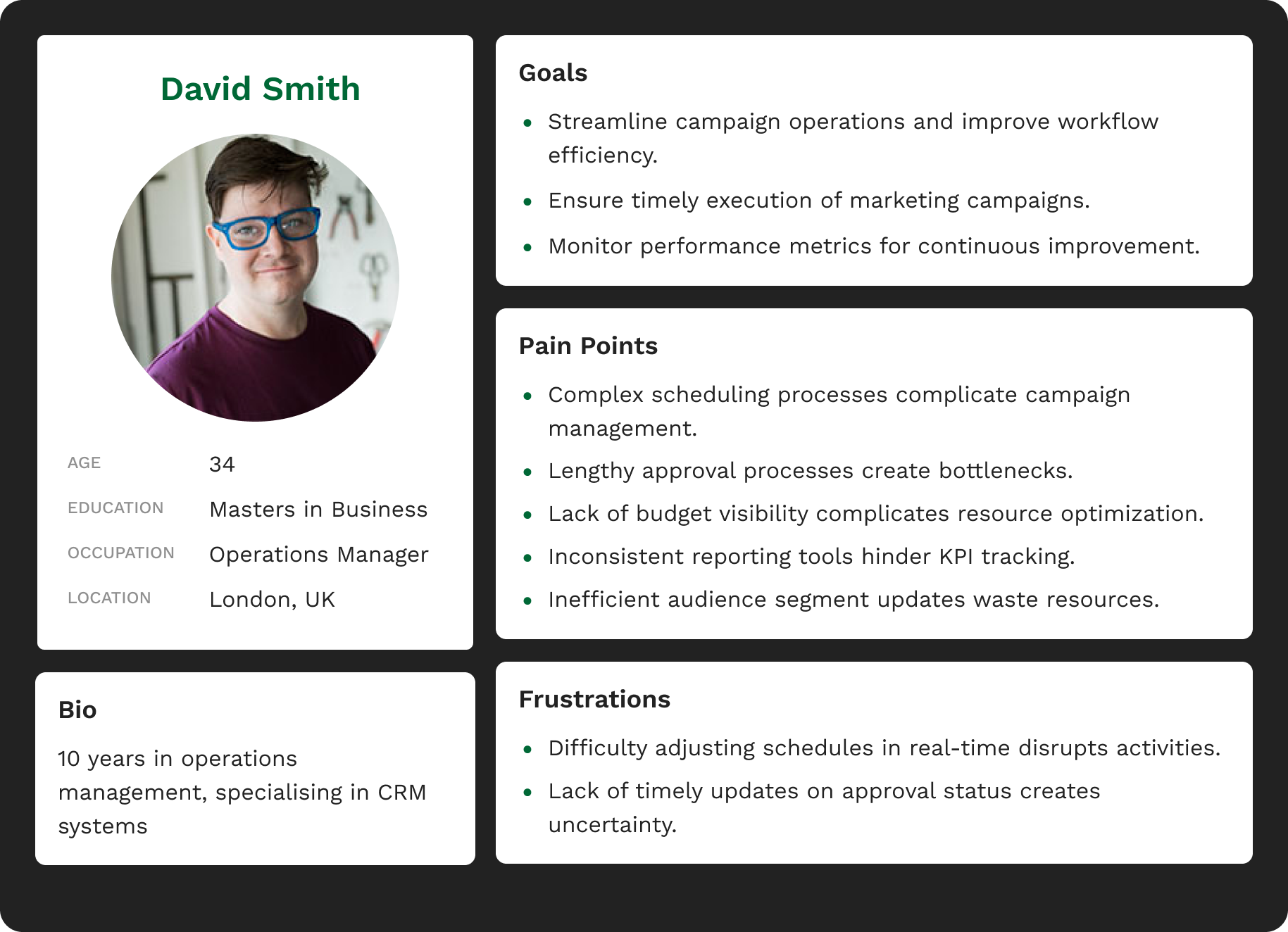
User Personas
After reviewing the research materials and engaging with various stakeholders, I developed user personas for two distinct roles: Marketing Head and CRM Operations Manager.
Ideation
Some of the problem statements and their potential solutions:
After analysing the research outputs, including pain points and recommendations, I held ideation and brainstorming sessions to develop effective solutions that address the identified challenges.
Problem: Difficulty aligning label-level goals with organisational OKRs.
Pain point: Lack of real-time tracking and measurable progress hampers effective goal management.
Solution: Implement AI-driven goal-setting tools that automatically align label-level goals with organisational OKRs, offering real-time tracking and predictive analytics for progress measurement.
Problem: Limited segmentation options lead to ineffective targeting.
Pain point: Outdated data results in poor audience targeting and lower campaign performance.
Solution: Enhance audience segmentation capabilities by incorporating player attributes and activities (both past and future), allowing saved groups for reuse across various campaigns, along with AI suggestions.
Problem: Manual budgeting processes are error-prone and lack dynamic adjustments.
Pain point: Poor visibility into budget utilization complicates resource allocation.
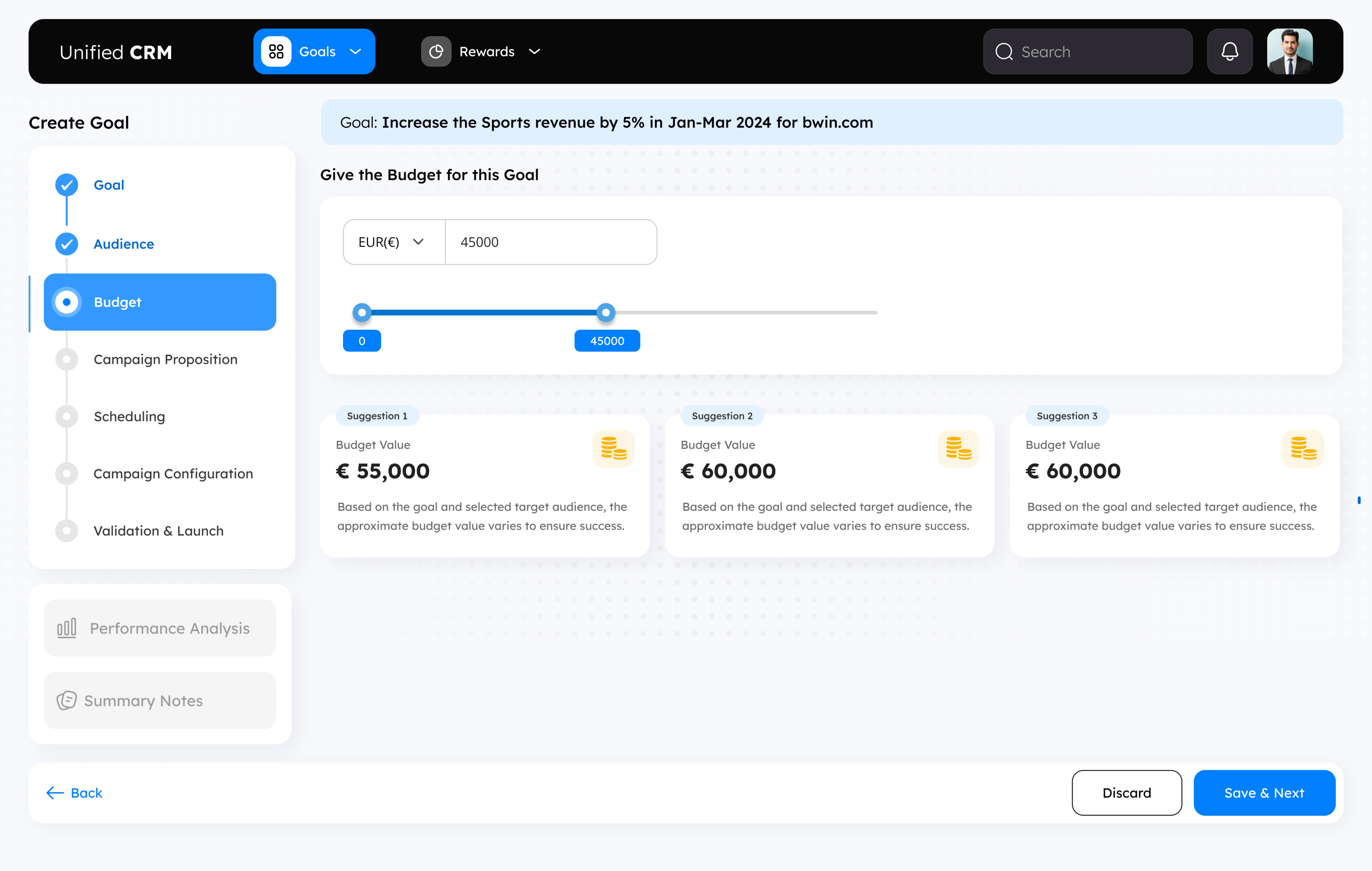
Solution: Leverage AI to automate budget allocation by analyzing campaign performance data in real time, allowing for dynamic adjustments and providing insights into budget utilization across campaigns.
Problem: Limited flexibility in designing reward strategies.
Pain point:Difficulty in tracking the effectiveness of different reward types impacts campaign success.
Solution: Employ AI to recommend personalised reward propositions based on audience behaviour and preferences, with the ability to track effectiveness through machine learning models.
Problem: Complex scheduling processes create inefficiencies.
Pain point: Lack of a streamlined interface and real-time adjustments leads to missed opportunities.
Solution: Introduce an AI-driven scheduling assistant that suggests optimal timelines for campaigns, sends reminders for upcoming events, and allows for real-time adjustments without disruption.
Problem: Challenges in defining relevant KPIs hinder performance measurement.
Pain point: Limited ability to track KPIs in real time complicates quick decision-making.
Solution: Use AI to define and optimize relevant KPIs automatically, providing real-time tracking and analytics tools for comprehensive performance measurement across campaigns.
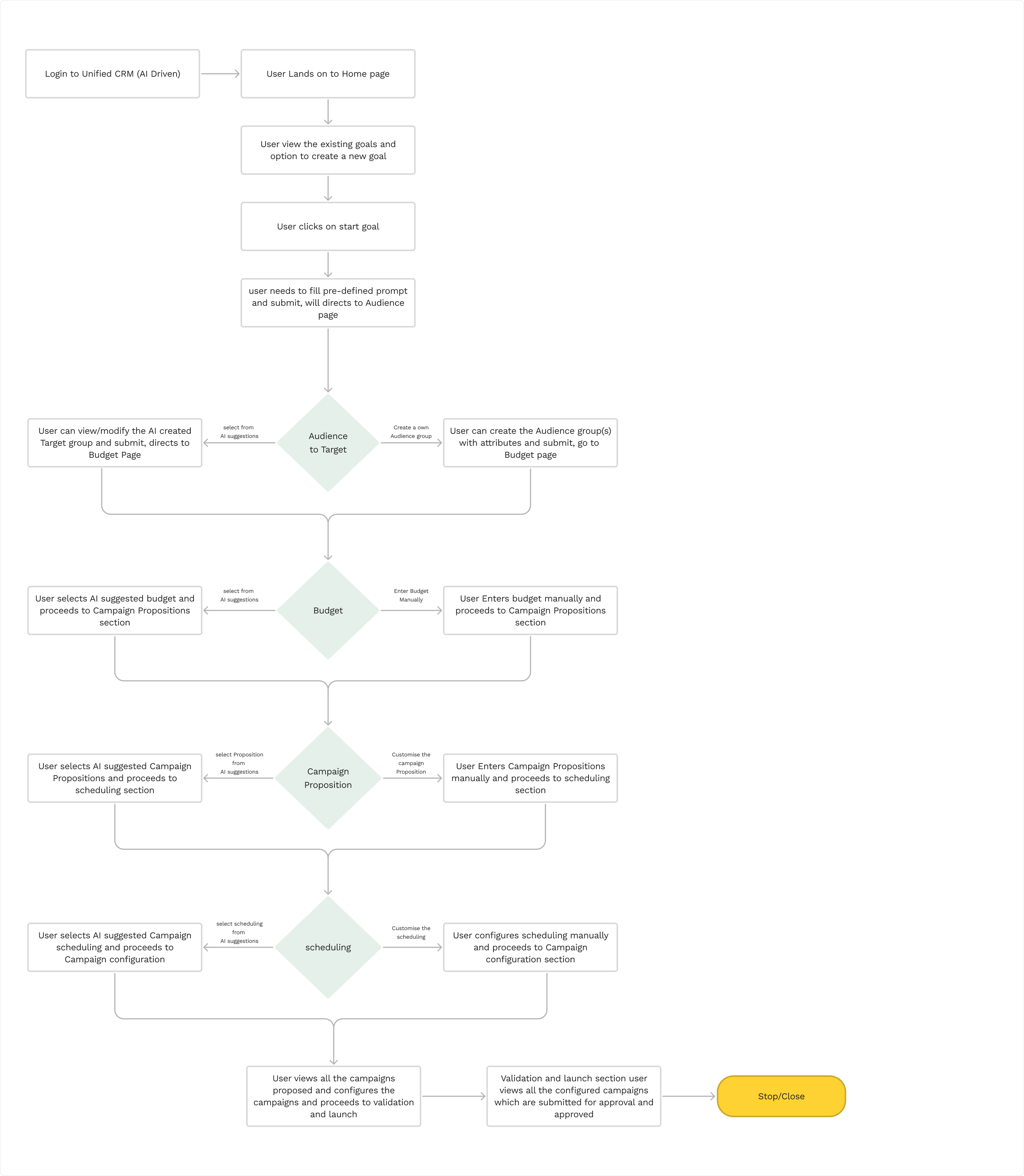
Task Flow
With the finalised solutions from various iterations, I proposed a refined task flow for the "Goal Creation" process
Design Solutions
Feedback and Next steps
Wireframes
Once the solutions were finalized, I transformed conceptual ideas into tangible visual representations, beginning with low-fidelity designs. As part of the design process, I proposed the integration of conversational AI to enhance user interaction and streamline workflows,
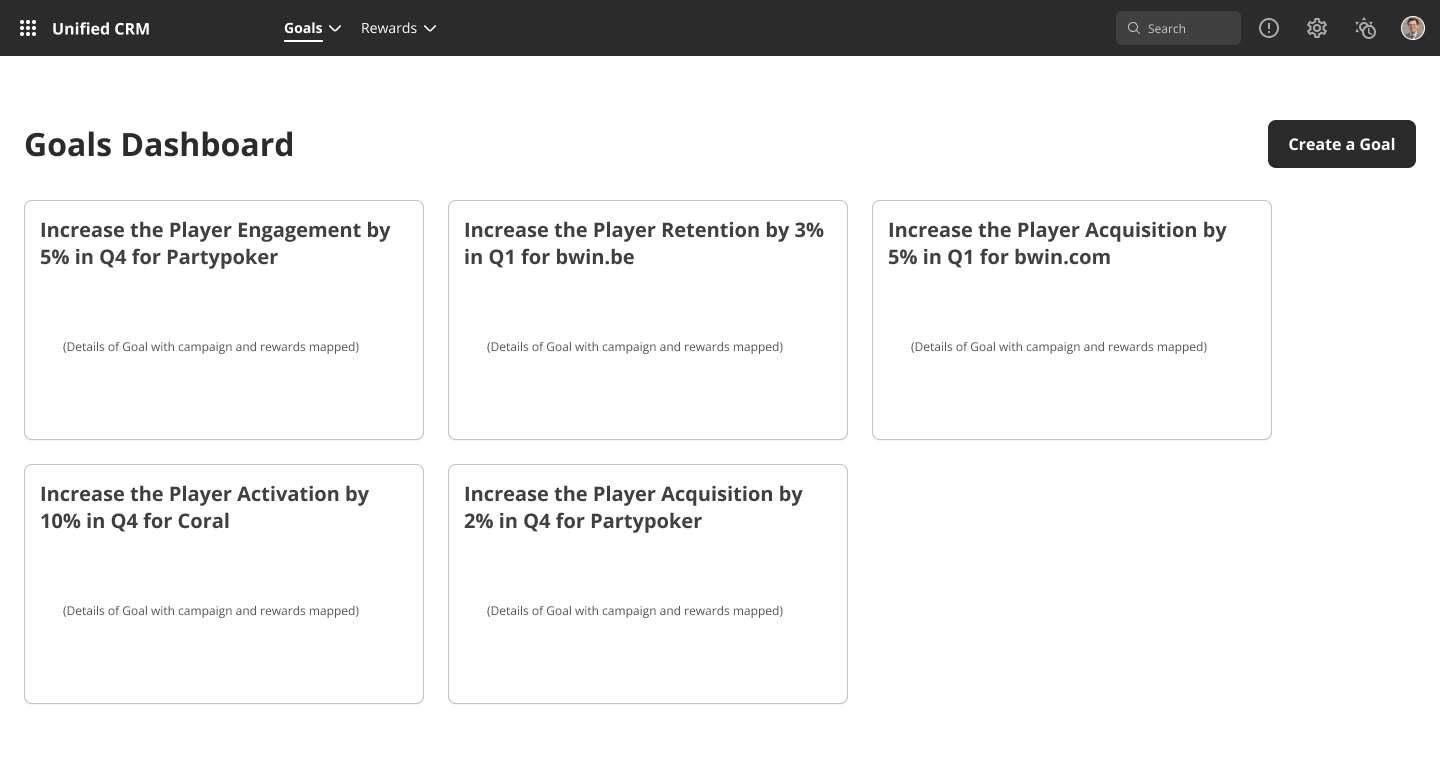
Goals Page Overview
The "Goals" page allows users to view, manage, and create label-level goals aligned with organisational OKRs.
- Existing Goals Overview: Users can view all active, pending, and completed goals, with details like budget and progress. Filters and sorting options help users locate specific goals.
- Create New Goal: A prominent "Create a New Goal" button guides users through setting a goal, assigning a budget, and linking it to OKRs.
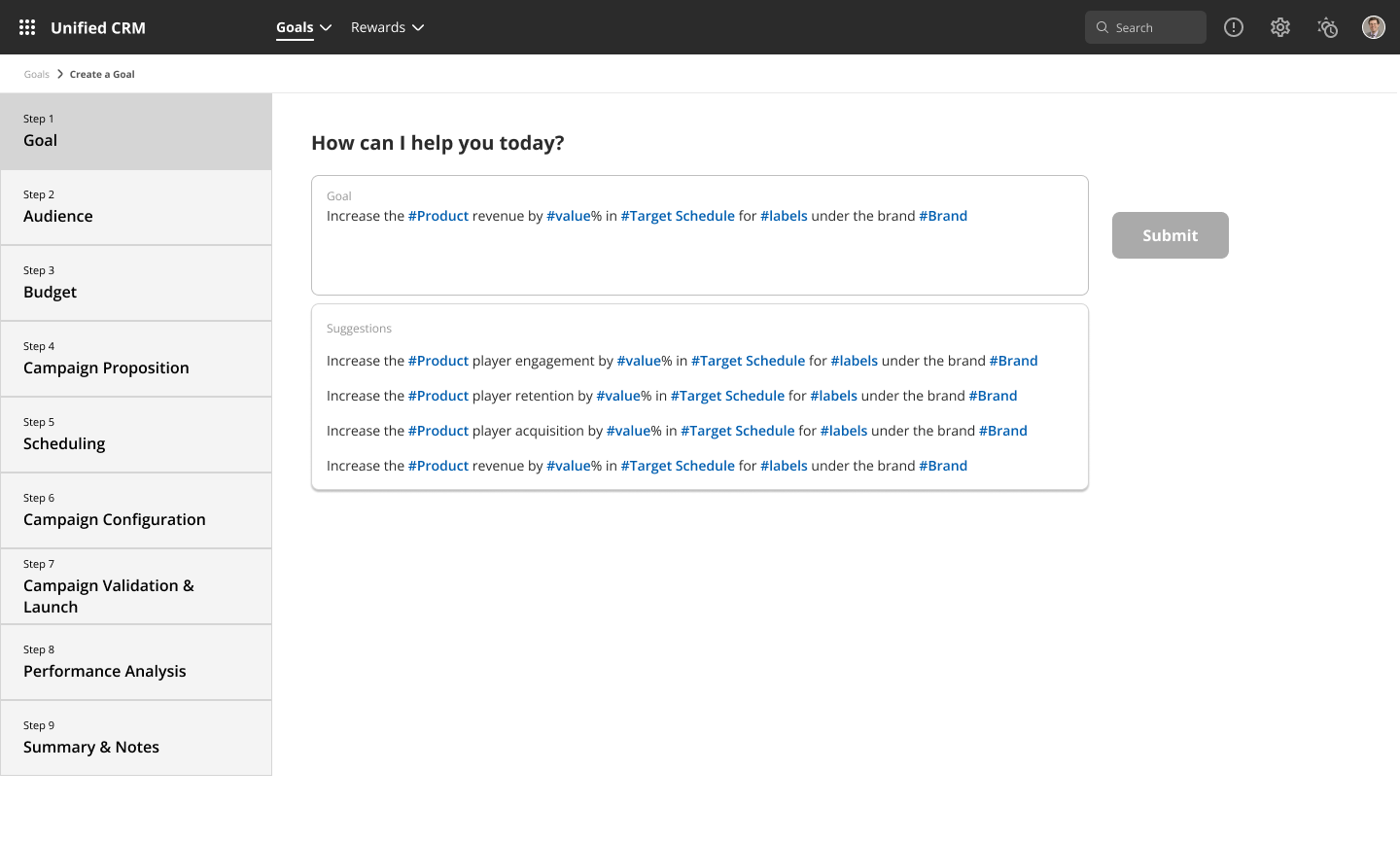
Defining the Goal
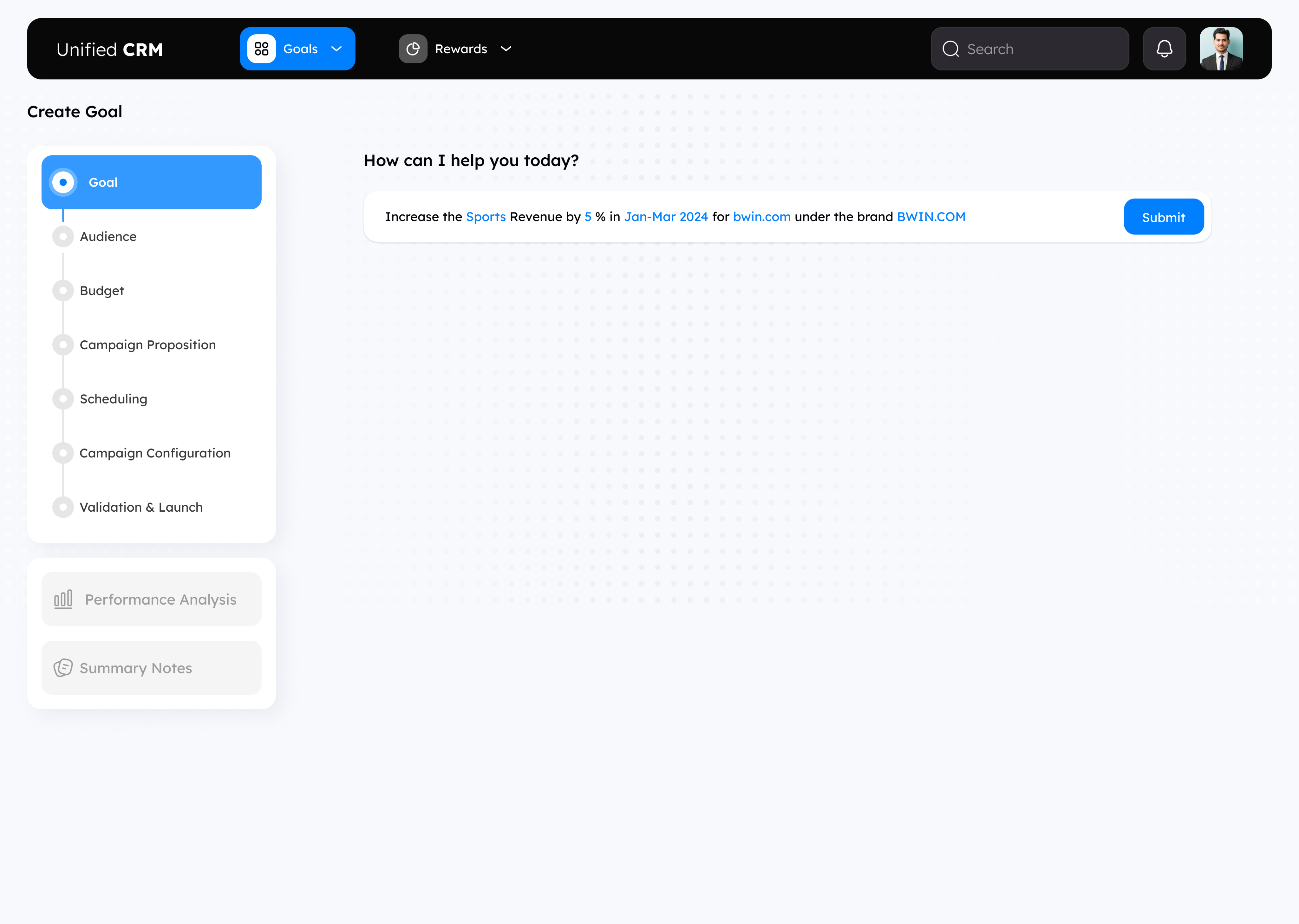
- Once the user begins the goal creation process, they are guided to define the goal. The AI interface suggests a structured form with editable/selectable inputs, making it intuitive to set up. Predefined prompts assist the user in aligning their goal with common business objectives like player acquisition, retention, or engagement.
- Users can choose from pre-set options for key elements such as products, labels, and target values, ensuring consistency with organisational OKRs.
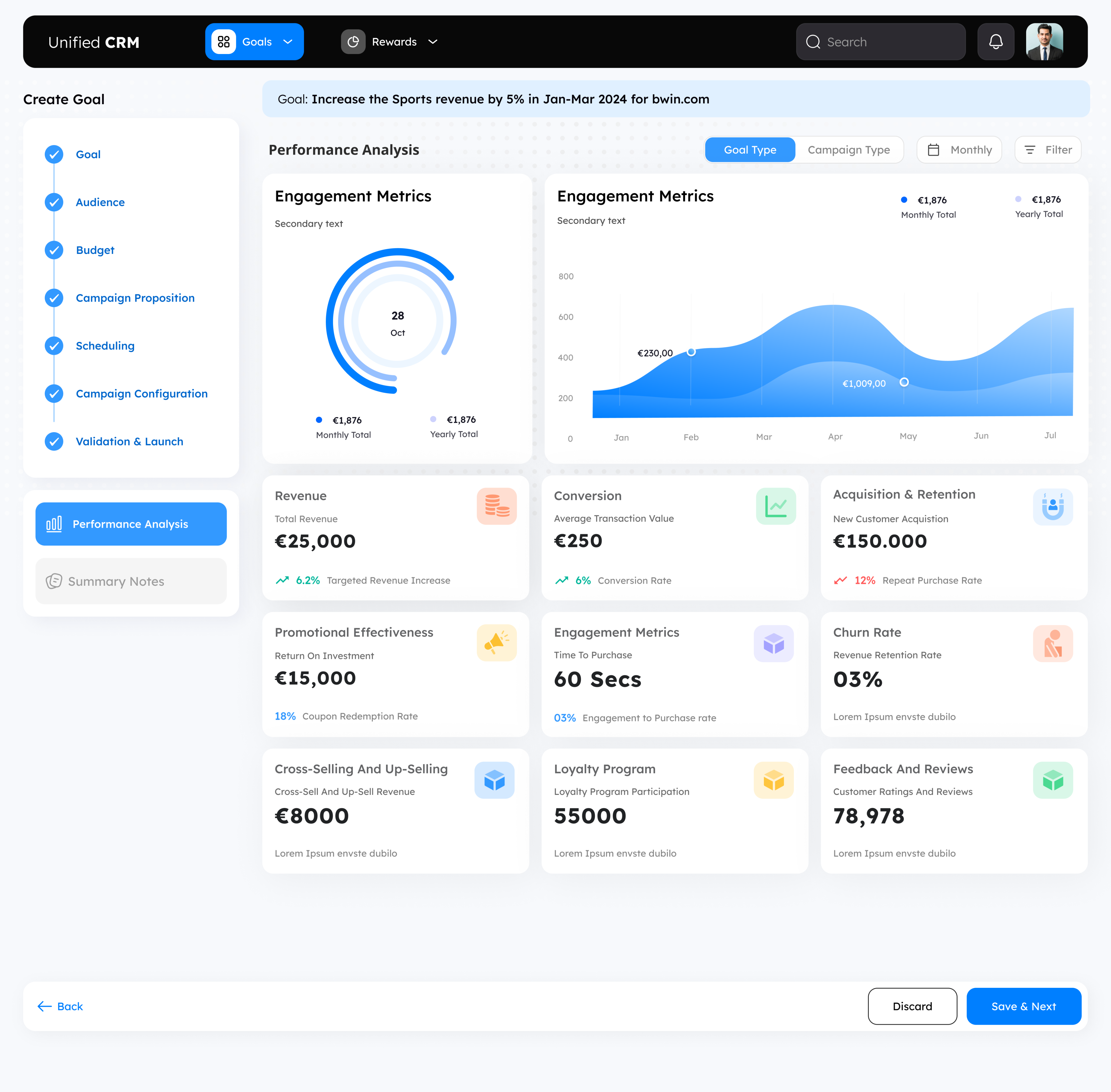
Performance Analysis Screen
Performance analysis provides a comprehensive view of how a goal is performing by leveraging various KPIs (Key Performance Indicators). It begins tracking and evaluating performance as soon as the associated campaigns go live. This process continuously monitors critical metrics, such as user engagement, conversion rates, churn Rates, and acquisition. By offering real-time insights into the effectiveness of campaigns, performance analysis enables users to assess whether the goal is being met and, if necessary, adjust strategies to optimize outcomes. This analysis helps in making informed decisions and taking corrective actions if needed.
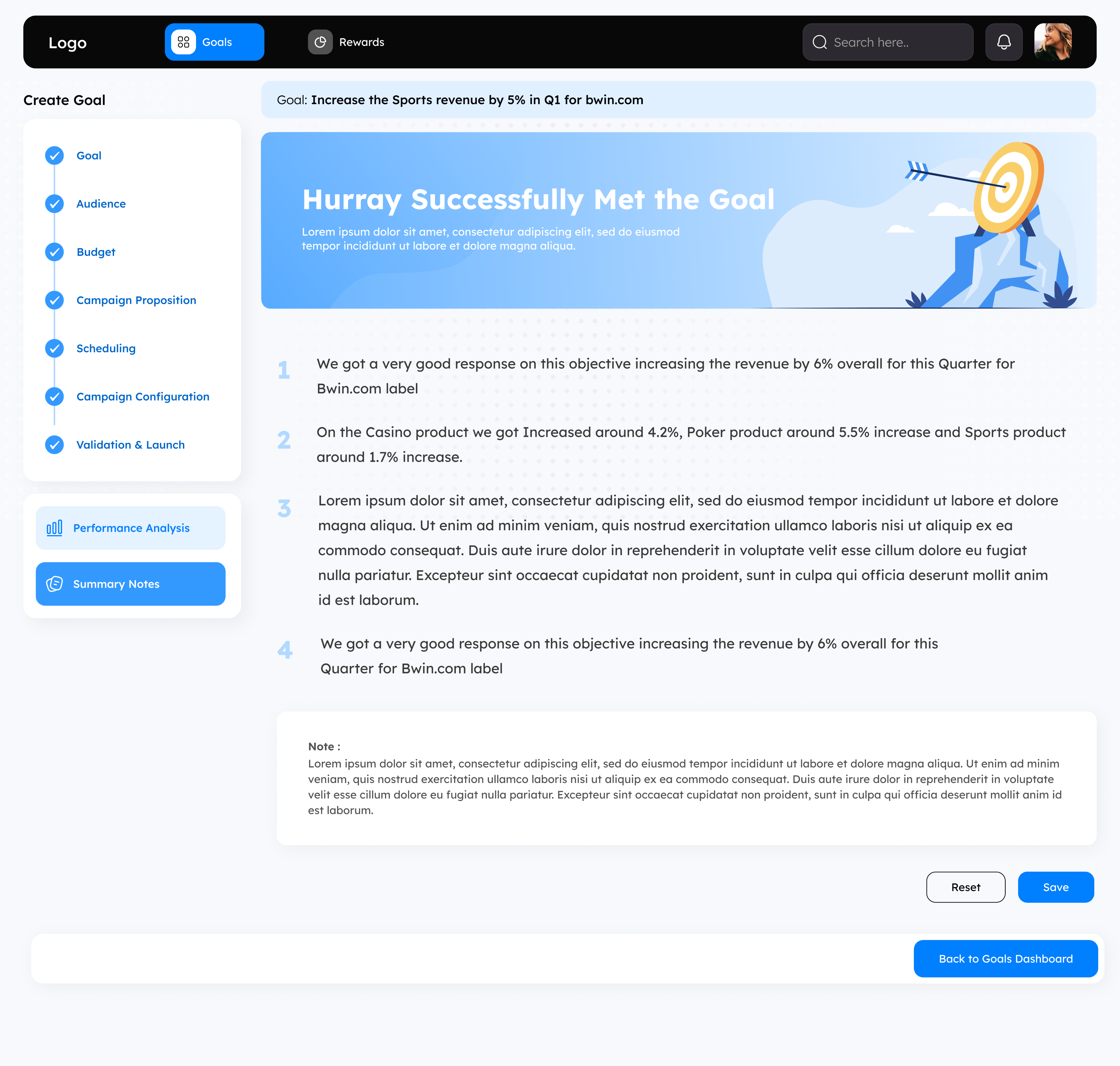
Summary Notes
Once the goal timeline concludes and the associated campaigns have run their course, AI will automatically generate a detailed summary note. This summary will include key accomplishments from the goal, highlighting both the positive outcomes and areas that fell short of expectations. The AI will analyze data across various metrics—such as user engagement, budget efficiency, and campaign performance—to provide actionable insights.
The report will outline the strengths, such as successful audience targeting, high engagement rates, or efficient budget utilization, while also identifying negative aspects like underperforming segments, misaligned reward strategies, or KPIs that were not met. With this comprehensive overview, the user can make data-driven decisions when setting up future goals, refining strategies to enhance performance and achieve better alignment with business objectives.
After completing the designs with multiple iterations, I presented the prototypes to various stakeholders and business teams. The feedback was overwhelmingly positive, highlighting several key points:
- Positive Reception: The AI-driven, futuristic approach was well-received, with stakeholders praising its innovative potential and ability to streamline CRM processes.
- Game-Changing Innovation: The design is seen as a game-changer for CRM applications, offering advanced features that far surpass traditional campaign management systems.
- Consolidation of Tools: Stakeholders acknowledged the potential for this solution to consolidate all existing campaign management tools, centralising operations under one unified platform.
- Efficiency and Scalability: The proposed solution was lauded for its ability to significantly enhance efficiency, scalability, and real-time insights, providing marketing teams with more control and flexibility.
- Strategic Alignment: Business teams appreciated the alignment of the tool with organisational goals, particularly in terms of optimising customer engagement, resource allocation, and campaign performance.
Despite receiving positive feedback from all stakeholders and business teams, the development phase requires approvals and resource allocation. We are currently awaiting these steps to proceed and look forward to kicking off the remaining design flows.
Campaign Propositions
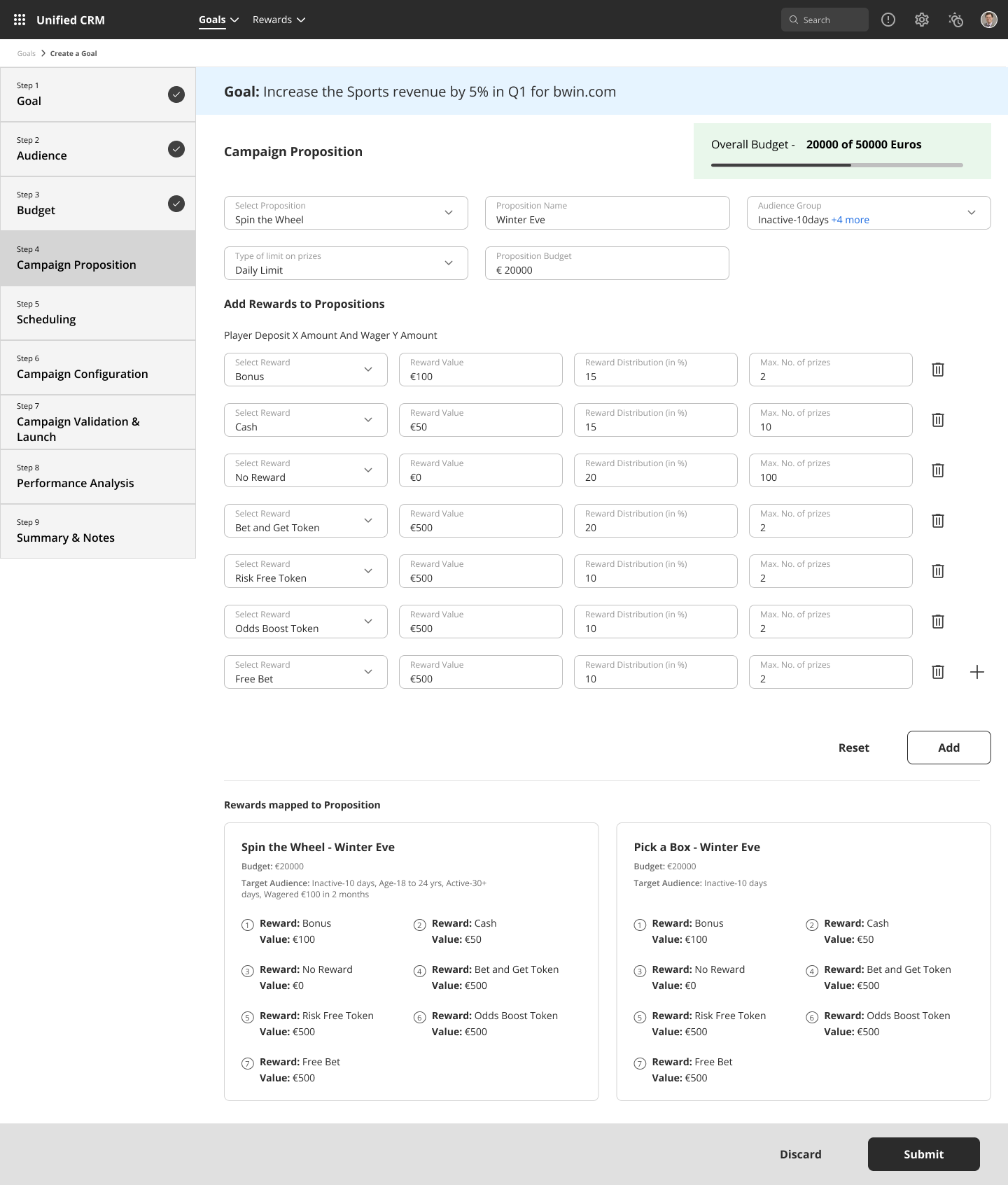
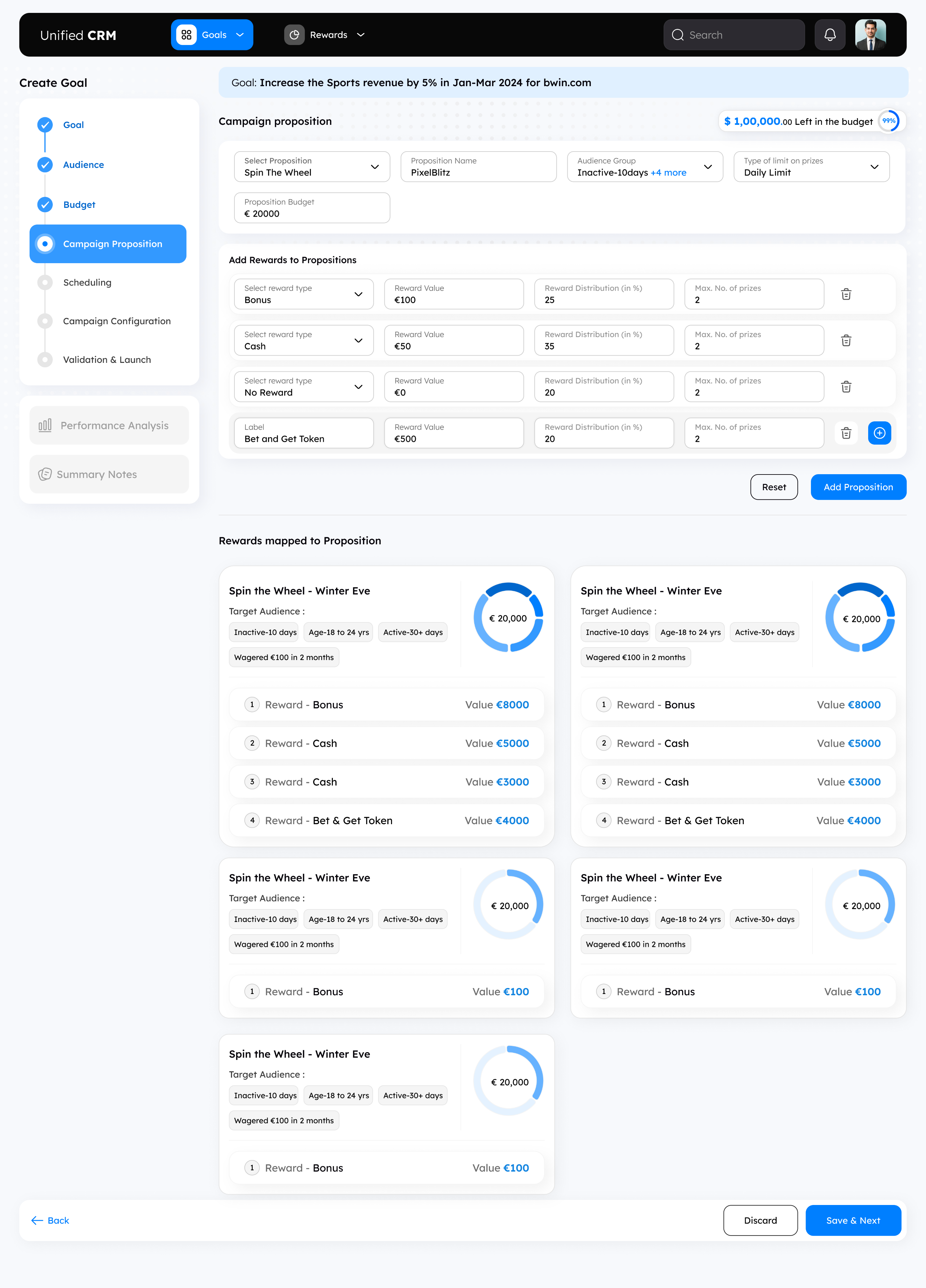
- Once the budget is added, the user can either select campaign propositions from AI-generated suggestions or manually create propositions. This flexibility allows users to choose rewards based on predefined AI insights or customize them according to campaign needs.
- While creating campaign propositions, users define key elements such as prize value, award distribution, and maximum limits. The system dynamically adjusts the proposed budget in real-time, ensuring that the reward values align with the overall campaign budget. Users can apply these rewards directly or link them through different campaigns, offering better control over resource allocation.

Campaign Configuration
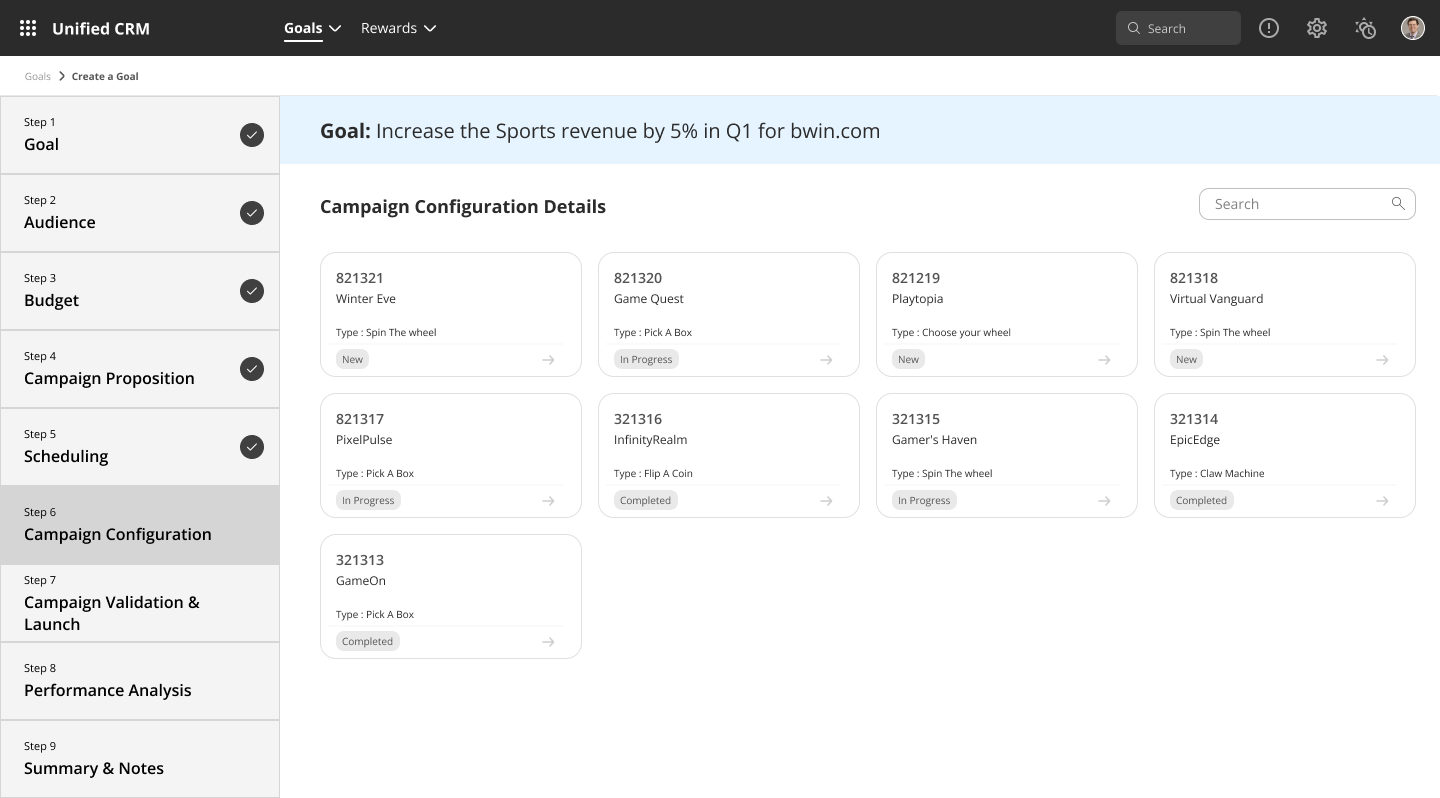
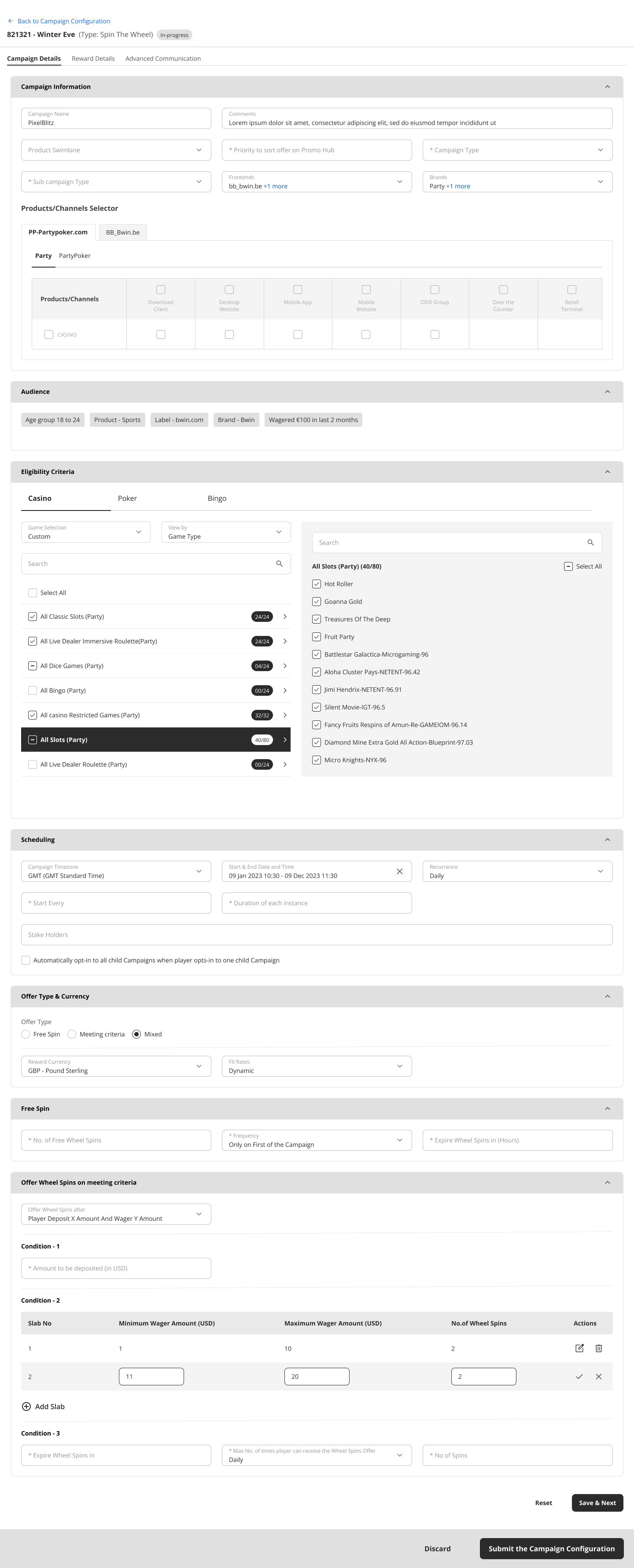
- After creating the goal, proposing a budget, and scheduling the campaign propositions with rewards, the next critical step involves configuring these propositions.
- The campaign configuration page displays all campaign drafts that require validation and configuration. Most data fields will be autofilled based on the user's previous selections and inputs, allowing for a more efficient setup. Users will only need to fill in any remaining fields, ensuring a smooth transition to the validation and launch phases.
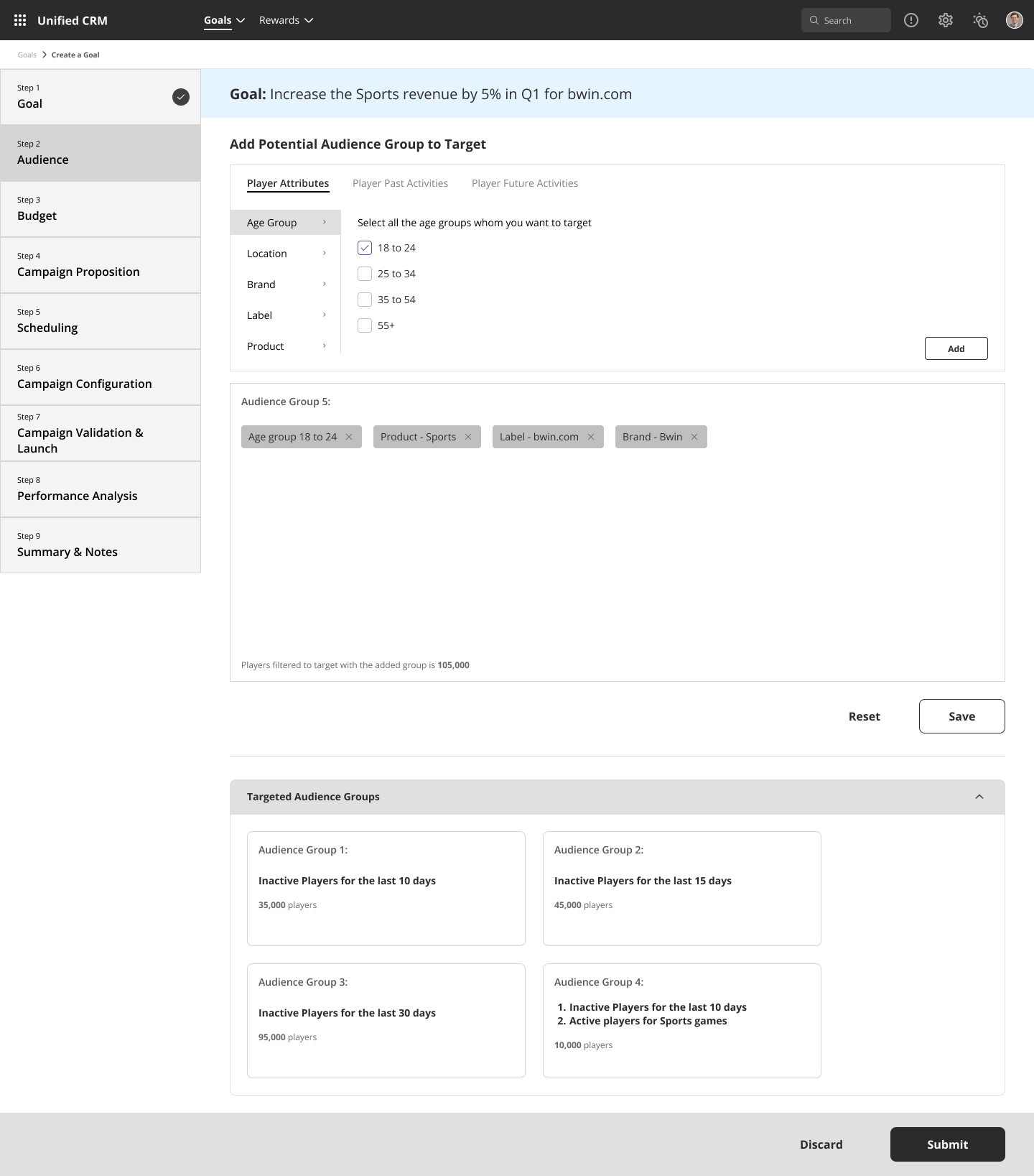
Audience Page Overview
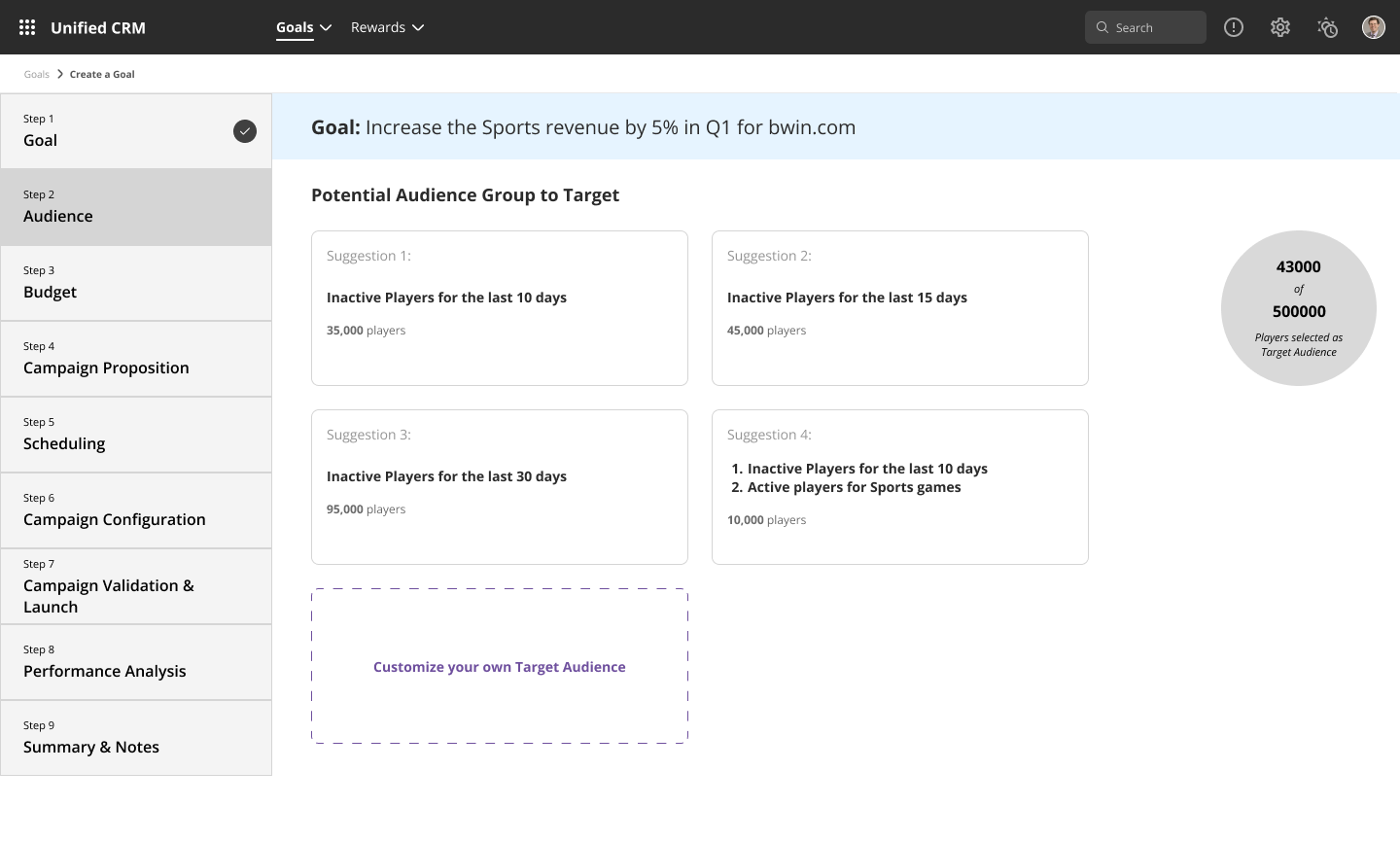
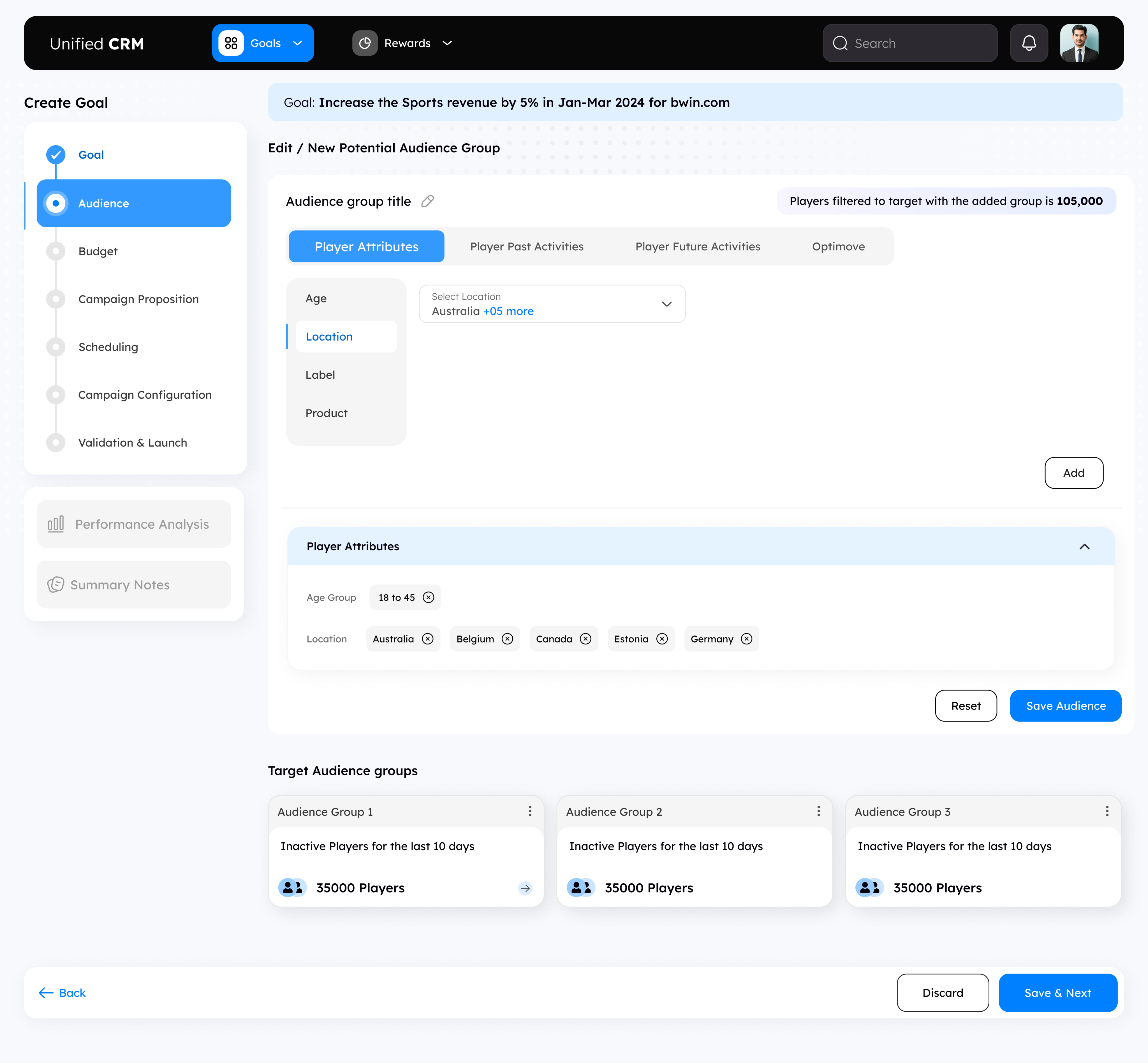
In the Audience section, users can either select from AI-suggested target groups based on the defined goal or create custom audience groups. When creating custom groups, users can choose from various entities such as player attributes (e.g., age group, location), past activities (e.g., active/inactive status, deposits, wagering), and future predicted activities (e.g., future logins, deposits). This flexibility ensures precise targeting for more effective campaigns.
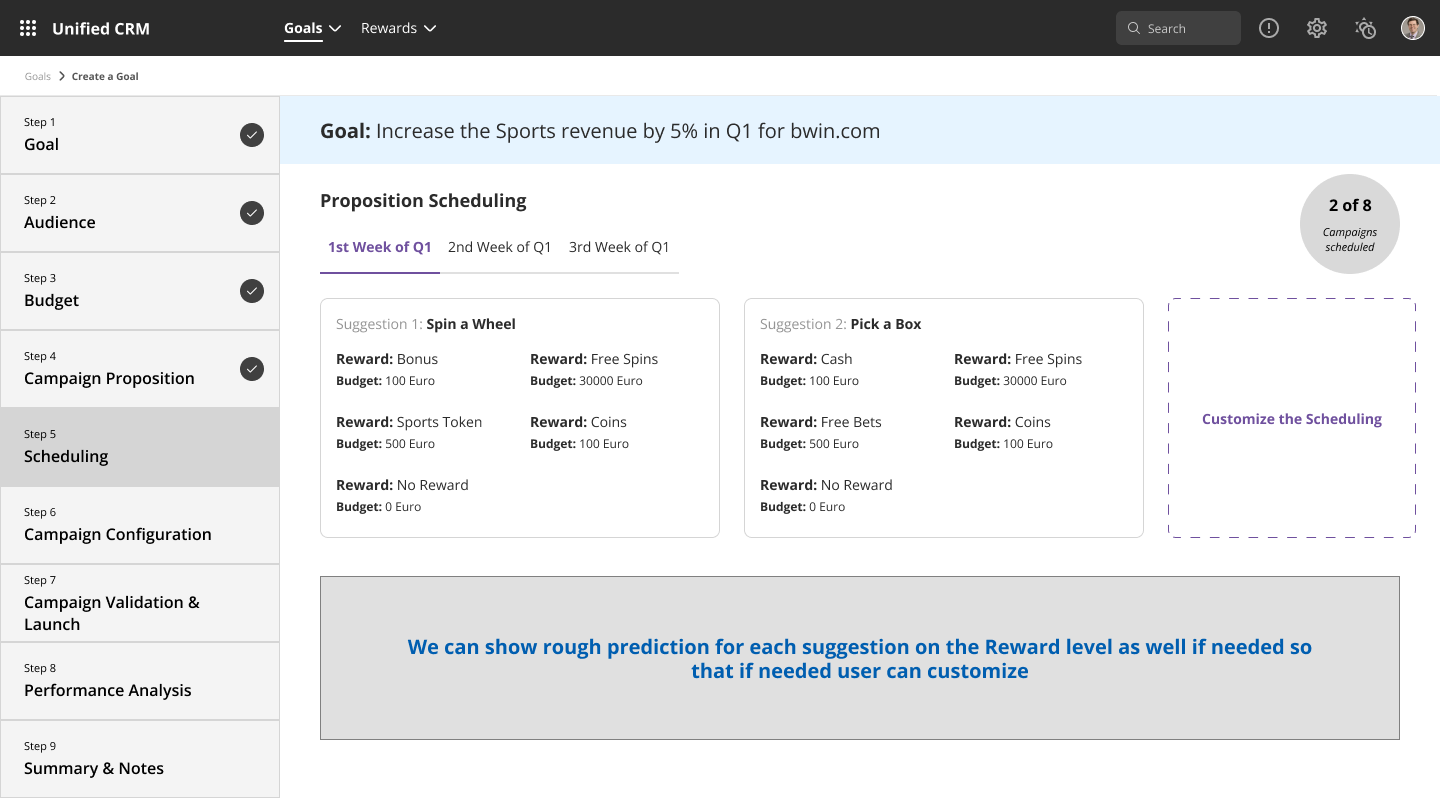
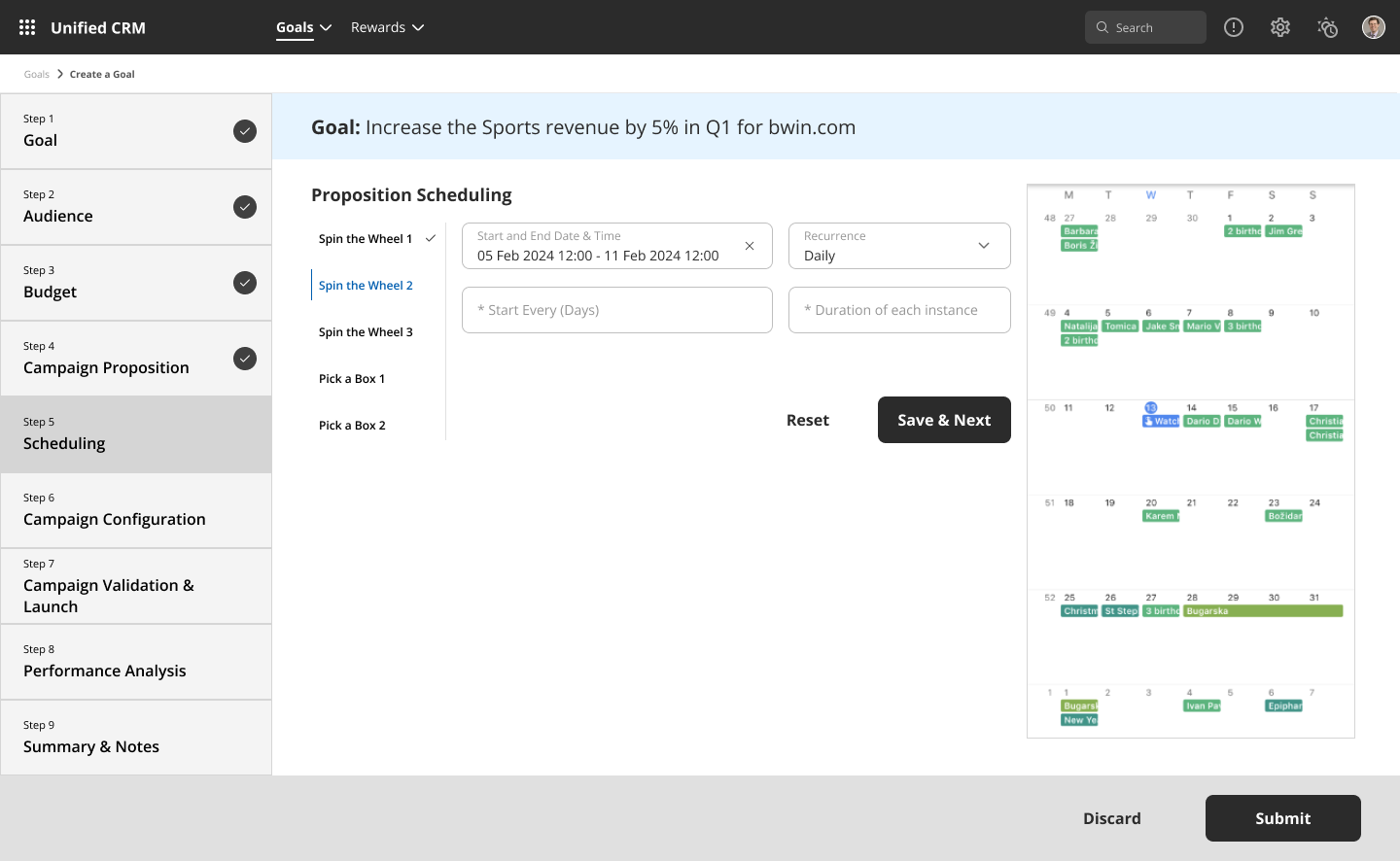
Scheduling Page
- Users have the option to begin scheduling each campaign proposition based on AI recommendations. The AI system suggests optimal timings for launching campaigns, taking into account factors such as past performance, audience engagement, and peak activity times, streamlining the scheduling process for efficiency.
- Users can manually schedule campaigns using an advanced calendar interface. This calendar provides a comprehensive view of all active and upcoming campaigns, allowing users to visualize and manage overlaps, gaps, or potential conflicts. This feature helps in better planning and coordination, ensuring that campaigns are strategically timed for maximum impact.
Final UI Screens
- Complexity of Integrating AI: Designing intuitive interfaces for AI-driven features like predictive analytics, real-time suggestions, and automation while keeping the user experience seamless and understandable.
- Balancing Flexibility and Usability: Catering to diverse users, from marketing heads to operations managers, requires designing a flexible system without overcomplicating the interface.
- Managing Diverse Campaigns: Ensuring the platform supports the creation and management of various campaigns (e.g., engagement, retention, etc.) while maintaining ease of use for non-technical users.
- Data Overload: Presenting AI-driven insights, KPIs, and performance metrics without overwhelming users, ensuring clarity and actionable information.
- Approval Workflows: Designing efficient approval processes that cater to different stakeholders while avoiding bottlenecks and maintaining workflow transparency.
Challenges and Learnings with this product